 DefenseReview.com (DR): An online tactical technology and military defense technology magazine with particular focus on the latest and greatest tactical firearms news (tactical gun news), tactical gear news and tactical shooting news.


By David Crane
defrev (at) gmail (dot) com
Photo Credits: Sturm Ruger & Co., Inc.
June 7, 2009
Updated on 6/16/09
Ever since the late Bill Ruger Sr. (William Batterman Ruger) actively assisted the anti-gun/anti-Second Amendment Democrats in Congress institute the 1994 Federal Assault Weapons Ban (AWB) a.k.a. the Violent Crime Control and Law Enforcement Act of 1994 by introducing the idea of a 15-round capacity limitation for firearms magazines (which subsequently got reduced to 10-rounds in the actual legislation) and even presenting model/sample legislation to Congress that included the idea, I haven’t been a very big fan of Bill Ruger Sr. or his company, Sturm Ruger & Co., Inc. Because of that, to this day, I’ve never purchased or owned a Ruger firearm, and I don’t feel all that guilty about it, frankly. I’ve researched Bill Ruger Sr.’s actions leading up to the 1994 “Assault Weapons” ban, and I’ve determined that his actions were less-than-intelligent, short-sighted, tremendously misguided, selfish, and absolutely betrayed the firearms industry, gun owners, the Second Amendment (and therefore freedom, itself), and thus the country. Basically, old Bill did a very, very bad thing–and his advanced age was no excuse. I therefore believe that Bill Ruger Sr. was deserving of a lot of gun people’s resentment, including mine. It’s therefore somewhat ironic that Ruger is now introducing a 30-shot gas piston/op-rod-driven AR-15 tactical carbine, a gun that is only possible due to the expiration of the very gun ban that Bill Ruger Sr. assisted in bringing to fruition.
In its article on the introduction of the new Ruger SR-556 short-stroke gas piston/op-rod AR carbine (AR-15 carbine), The Firearm Blog stated the following about the company: “Ruger was that attractive girl at high school who you wanted to love but she stabbed you in the back and you just could not trust her again,” which is an interesting way to put it. However, it went on to state: “That was two decades ago. Sturm, Ruger & Company CEO Michael O. Fifer has listened us, the customers, and changed the company culture for the better. There is no better illustration for this change than the Evil Black Rifle itself which has just joined the Ruger product offering.”
 DefenseReview doesn’t know Mr. Fifer, so we can’t back up The Firearm Blog on their assessment of him, but we’d like to believe them and we’re willing to give Mr. Fifer the benefit of the doubt. Everyone deserves forgiveness and a fresh start every once in awhile. This includes companies like Ruger, particularly when new management takes over and institutes a new corporate culture and/or philosophy, and they’re sincere about it. We’re therefore willing to give the semi-auto-only SR-556 5.56x45mm NATO (5.56mm NATO)/.223 Rem. gas piston/op-rod-driven AR-15 carbine an honest shot–excuse the pun–whenever we can get our hands on one for T&E. However, we’re skeptical as to how successful the SR-556 will be in the market, considering what it’s up against.
1) It’s up against the aforementioned residual resentment within the tactical firearms community, which is well-founded.
2) It’s up against all of the current 5.56mm/.223 gas piston/op-rod (operating rod) AR offerings out there, including complete gun solutions like the LWRCI M6A2 rifle/carbine, POF-USA P-415 rifle/carbine, and soon to be offered Heckler & Koch (HK) MR556 carbine/rifle, which is the semi-auto-only version of the HK416 (also written HK-416 or HK 416). And, let’s not forget the gas-piston/op-rod complete upper receivers and conversion kits like the Primary Weapons Systems (PWS) DC-16 Upper, 5.56 complete upper receiver, currently built and marketed by ADDAX Tactical as the ADDAX GPU Gas Piston Upper, and the Adams Arms Retrofit Gas Piston System (RGPS) conversion kit.
3) It’s up against the growing skepticism and doubt about the supposed superiority and/or advantages of gas piston/op-rod ARs over traditional direct-gas impingement (DGI) a.k.a. direct-impingement gas (DI Gas) system AR-15 carbines/rifles. with regard to weapon reliability. There are a couple of important points to be made about this. First, as we’ve already pointed out in a previous article, there are a number of very knowledgable people out there, including, but not limited to, tactical AR-15 builders out there like John Noveske of Noveske Rifleworks, LLC and Nathan Roads of Next Generation Arms (NGA) and professional military Spec-Operators (including U.S. military Special Forces and Special Operations personnel) that actually prefer the traditional DGI setup over the gas piston/op-rod setup. Not only do traditional direct gas guns tend to be more accurate, lighter-weight, softer and smoother shooting, and mechanically simpler than gas piston/op-rod guns, but there is now growing evidence that they may be as or more combat-reliable and/or durable than some gas piston/op-rod guns, provided the DGI guns (like the Colt M4A1 Carbine, for example) are “sprung right“, are properly maintained, and have a barrel of at least 12.5 inches (12.5″) in length. A direct-gas AR-15 SBR with a 12.5″ barrel can retain and utilize the standard M4/M4A1 Carbine-length gas system, thus optimizing weapon reliability. Piston guns are easier to clean/maintain in the field since they don’t get as dirty inside and don’t run as hot, thus requiring less lubrication maintenance. However, the “crud” that builds up inside a DI gas (Direct Impingement gas) AR at high round count is not what causes reliability problems. Improper “springing” and lack of proper maintenance (replacing springs and worn-out parts and providing adequate lubrication) are the most common cause of malfunctions in DGI ARs, not the dirt in the action. Maintain them properly, and they will run.
 Remember, the reason that a certain U.S. Army Special Forces (SF) unit chose the HK416 piston-driven platform was because they wanted a short weapon with a 10.5-inch (10.5″) barrel that would run reliably with a muzzle can (silencer/sound suppressor). A gas piston/op-rod setup doesn’t rely on barrel length to create the necessary gas pressure curve and timing like a direct-gas-impingement system does, so you can cut the barrel down to 10.5 inches with no loss in weapon reliablity. However, if you’re willing to go with a barrel length of 12.5 inches and up, it’s questionable that a gas piston/op-rod gun offers ANY reliability or durability advantage whatsoever over a direct-gas gun, even with a suppressor attached.
In fact, there’s now some evidence to the contrary, since the much vaunted and supposedly superior HK416 has been running into some rather serious reliability and durability problems in the field as of late, including the piston system locking up in cold weather and the upper receiver cracking. And, the HK 416 is supposed to be the most combat-proven gas piston/op-rod AR out there! According to some unconfirmed/unverified reports Defense Review has received from some of our industry contacts, the HK-416 receiver-cracking issue has led to U.S. Special Operations personnel operating under SOCOM (USSOCOM) to switch out their HK416s with Colt M4A1 Carbines, so they’re now back to using direct-gas-impingement guns. The fact is, the Colt M4A1 Carbine is truly combat proven, and significantly more so than ANY gas piston/op-rod AR out there, including the HK416, if you’re talking the total number of rounds fired through a given system/platform in actual combat. You just have to maintain the M4/M4A1–and any DI gas gun for that matter–more diligently and vigilantly than a gas piston/op-rod gun with regard to cleaning and lubrication schedules.
By the way, DefenseReview has read and heard good things about the LWRCI M6A2. It’s one of the best piston guns on the market. However, we’ve also read and heard about a few reliability/durability issues/teething problems in the past with the M6A2, although LWRCI (also written LWRC) may have resolved the issues in question and bulletproofed all the parts. We’re going to investigate it. We’re also going to try to obtain some testing data on the M6A3.
The POF P-415/16 is also one of the best piston guns out there, and we’ve gotten very good reports back on it. The P-415/16 utilizes a FN FAL-type piston and operating rod with no spring as opposed to the usual AR-18-type piston and op rod system (HK416, M6A2, etc.), which does incorporate a spring, so it’s possible that the P-415/16’s operating system is the simplest and most robust/rugged of the piston-driven bunch. The P-415-16 is also easy to maintain.
Editor’s Note: For the record, DefenseReview likes both the LWRC M6A2 and the POF P-415-16, and thinks both are excellent products worth owning for any tactical AR enthusiast. We also recommend that people own at least one quality direct gas AR and one quality piston AR, if they can afford to purchase both.
Getting back to the topic of suppressors for a second, there are a couple of things that can be done to a traditional DGI AR-15 carbine/subcarbine/SBR (Short Barreled Rifle) to optimize it for use with a suppressor. One option to explore is coating the weapon’s internals (internal components and parts) with a modern high-tech self-lubricating/self-lubricitous coating like UCT Coating’s/FailZero’s nickel-boron (Ni-B) EXO Technology coating or Next Generation Arms’ ceramic coating. These coatings reduce the ability of carbon or any other type of particles to stick to the insides of the weapon, thereby signficantly easing maintence, and potentially increasing weapon reliability, although this would have to be extensively tested, especially when the weapon is outfitted with a suppressor. DefenseReview does not have any official and verifyable testing data as yet confirming any weapon reliability enhancement when these coatings are applied. Defense Review would want to test weapons in suppressed and unsuppressed modes at high-round-count under adverse conditions in order to confirm any potential reliability advantage. To reduce gas and particle backblast when using a suppressor on a DGI AR carbine/SBR, you can replace the standard cocking/charging handle with a PRI M84 Gas Buster Charging Handle – Military Big Latch, made by Precision Reflex, Inc.
As alluded-to above, it’s generally accepted that piston guns run cleaner than direct-gas guns. However, this may not hold true when the weapon is run suppressed. The following excerpt comes from our interview with John Noveske :
Crane: You’re not doin’ a piston gun, right?
Noveske: No.
Crane: Do you have any plans to do a piston gun?
Noveske: We have piston plans, but we don’t have any plans of putting it in production, because it’s…I don’t think it’s necessary. I’ve got piston guns here from other makers, and they’re dirty, and I don’t see…
Crane: Whadya’ mean “dirty”?
Noveske: Open up the bolt and look inside, and it’s dirty inside. The whole thing about them running clean is not necessarily…o.k., let me back up. I only run the guns with suppressors for testing when I did my comparison, and with suppressors, direct-impingement and piston-operated were both very dirty, ’cause the blowback comes to the chamber, not the gas tube. And, I’m not real happy with the piston systems that I’ve shot and examined, so it’s just to me, it’s not…
Crane: Well, the piston…the advantage for a piston with a suppressor on there is supposedly it doesn’t blow all the gunk back in your face.
Noveske: O.k., but what you’re not paying attention to is that all that crap comes back through the chamber, not the gas tube. On a piston gun or gas-impingement, the case is being extracted while the suppressor is still under pressure. Now you have all the pressure in that suppressor exiting both out the front and the back.
Crane: Right, but you’re saying the piston gun doesn’t solve that?
Noveske: It does not solve that. They’re both dirty.
Crane: So then how come you hear about guys saying yeah, when they’re shootin’ the direct gas impingement guns suppressed, or whatever, they’re gettin’ a lot of gas and particulate matter in their face, whereas with the piston, that it dissipates that a bit, or whatever.
Noveske: Maybe they had a different experience.
Crane: Hm. So, in other words, you’re saying that basically the piston doesn’t really offer any real advantage for that.
Noveske: What I’m saying, with a suppressor, direct-impingement and gas-piston both run dirty, and even a blowback gun or a delayed-blowback gun, like an H&K [Heckler & Koch], or any other operating system–I don’t really care what operating system you have–on an auto-loader, with a sound suppressor, they’re gonna’ all run dirty.
Crane: Right. Now, is a piston gun gonna’ put any less gas and particulate matter in your face, or are you gonna’ get the same amount?
Noveske: All a piston gun is gonna’ do different from gas impingement with a suppressor is reduce the amount that is coming through the gas tube. The piston gun is gonna’ eliminate that. I am not a scientist, but from my observations in shooting and examining the guns afterwards, it appears that the vast majority of the gas coming through is coming through the chamber. And, one example is go look at any of the HK91 or HK93-type rifles. Those have the fluted chamber and delayed blowback, and the cases are always black just like the case fired out of the gun with a suppressor. That’s because the case is extracting while it is still under pressure, and you have gas blowing back along the case as it’s blowing out, and covering it with carbon. And, that’s what’s happening with any autoloader with a suppressor. The cases all have carbon on them, because gas is escaping around the case out the chamber and into the receiver.
[DefenseReview received the following post-interview via email from John Noveske: “Also, we should mention the poor choice of platform for the piston conversion on a round receiver bore as found on the M16/M4 system. All other piston type systems out there utilize a railed receiver design, like the M14, AK-47, M249, FAL and so on. The round receiver bore design used on the M4 is only acceptable for the standard op system. The carrier and bolt expand on axis with the bore under the normal gas impingement cycle, but on a piston gun, you run into off center impulse issues with carrier tilt and incorrectly designed carrier contact points. Some designs attempt to address the carrier tilt problem with over sized carrier tails and rollers. I do not believe the receiver extension should be used in this manor. I know many people are very happy with their piston weapons. This is not meant as a knock on the piston conversion systems out there, but as a philosophical dialogue focused the new physiological relationships applied to the M16/M4 platform through the introduction of an operating system which has traditionally been applied to receivers with rails for the bolt and/or carrier. I would rather see an entirely new weapon system designed for the piston from the ground up. I believe there several outfits currently working on this.”]
Understand that even if you outfit an AR-15 carbine/SBR with a gas piston/op-rod, which the AR-15 wasn’t designed to utilize in the first place, you still have a round bolt carrier group moving/reciprocating inside a tight round tunnel in the receiver, instead of on rails, which is how it really should be done. So, you’re really only solving half the problem, if there’s even a problem to begin with–and that’s highly debatable. If you’re going to utilize a gas piston/op-rod arrangement, it’s best to design the gun for that system from the outset, rather than modifying or converting a direct-gas-impingement (DGI) gun to gas piston/op-rod operation. Check out a Kalashnikov rifle/carbine (AKM, AK-47, or AK-74) sometime, and see how the bolt group runs (slides back and forth) inside the weapon.
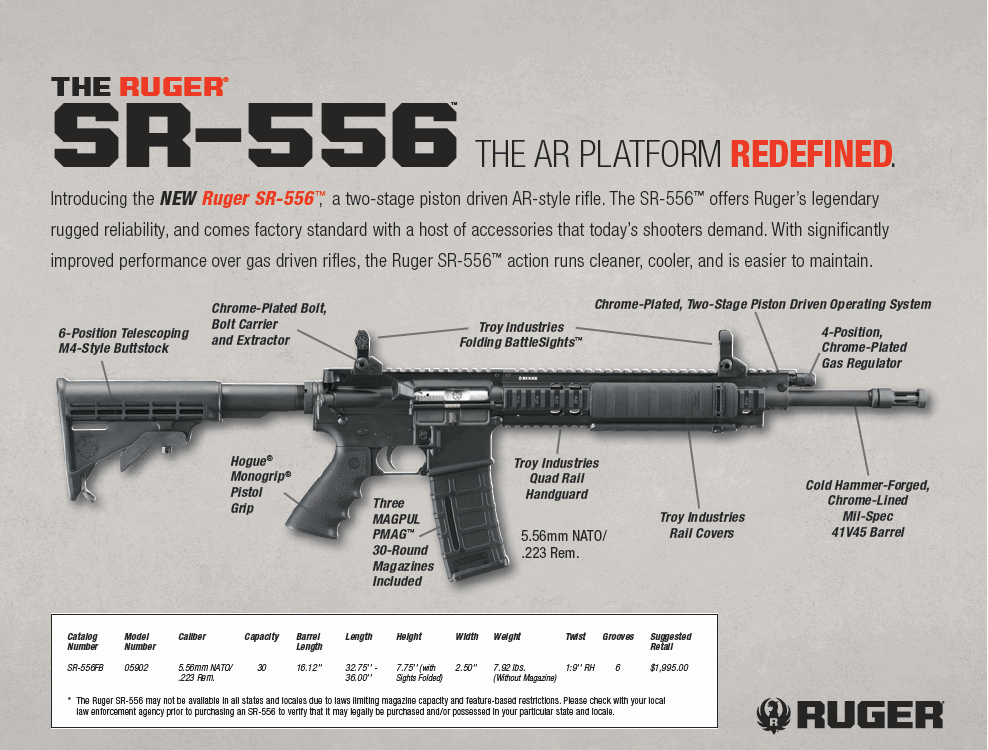
So, with all the current gas piston/op-rod choices out there (LWRC M6A2, POF P-415, PWS DC-16, etc.), all of which are more established and mature than the Ruger SR-556, why should one buy an SR556 at a suggested retail price of $1,995? Well, it’s another piston-driven design for your collection. Just don’t forget all of the traditional direct-gas AR-15 carbine (Stag Arms, Smith & Wesson, Armalite, and Bushmaster at mid-level, and Noveske Rifleworks, Next Generations Arms, Lewis Machine & Tool (LMT), Colt, Knight’s Armament Co. (KAC), and LaRue Tactical at the high end). At the moment, we’re somewhat neutral on the SR-556, although it’s always nice to see another tactical black rifle offering, as long as it exhibits good design and quality manufacturing. One of the things were going to investigate is whether or not the SR556 is completely debugged, or whether it has the normal/usual teething problems that most firearm designs/offerings experience when they’re first introduced. The SR-556 going to have to prove itself and establish it’s place alongside some pretty fierce competition.
Ruger SR-556 Weapon Specs:
Caliber: 5.56x45mm NATO (5.56mm NATO) / .223 Remington
Capacity: 30 Rounds
Barrel: 16.12″
Barrel Twist: 1:9 Right Hand
Weight: 7.92 lbs
Total Length: 32.75″ – 36″ (depending on stock position)
Stock: 6 position M4/M4A1 Carbine style
Exernal Coating/Finish: Manganese Phosphate, Hardcoat Anodized.
Features and Accessories:
– Chrome-Plated Gas Piston and 4-position Gas Regulator. The 4-Position Chrome-Plated Gas Regulator allows the operator to adjust gas pressure to compensate for weapon fouling and ammo power/impulse. It also allows him to turn the weapon into a single-shot rifle, if he desires.
– Chrome-Plated Bolt, Bolt Carrier, and Extractor
– Chrome-Lined Gas Block
– Full length Troy Industries Mil-Std-1913 “Picatinny” Quad Rail Handguard with Troy Industrys Rail Covers/Panels.
– Hogue Pistol grip.
– Ruger-branded Troy Industries BattleSights flip-up Back-Up Iron Sights (BUIS), front and rear.
– Ships with three 30-round Magpul PMAG magazines.
Sturm Ruger and Co., Inc. Contact Info
SR-556 Website: http://www.ruger.com/SR556
Newport Manufacturing Facility
411 Sunapee Street
Newport, NH 03773
Telephone: 603-863-3300
Fax: 603-863-3253
Pine Tree Castings Sales & Customer Service
411 Sunapee Street
Newport, NH 03773
Telephone: 603-863-2000
Fax: 603-863-4118
Ruger Export Firearms Sales
529 Sunapee Street
Newport, NH 03773
Telephone: 603-865-2424
Fax: 603-863-9371
Ruger RecordsDepartment
411 Sunapee Street
Newport, NH 03773
Telephone: 603-865-2424
Fax: 603-863-9371
Prescott Manufacturing Facility
200 Ruger Road
Prescott, AZ 86301
Telephone: 928-778-6555
Fax: 928-778-6633
Related Articles
Ruger SR-556: AR-15 has arrived (The Firearm Blog)
Norwegian soldiers having problems with HK416 (The Firearm Blog)
M4/M4A1 Carbine Reliability Issues Part II: Diagnosing the root cause.
M4/M4A1 Carbine Reliability Issues: Why They Occur, and Why They’re Our Fault!
Noveske Rifleworks N4 Light Recce Carbine: John Noveske Interview, Part One
PWS Diablo Long-Stroke Gas Piston/Op-Rod-Driven 5.56mm AR-15 SBR Upper
LaRue Tactical Stealth 16-Inch Upper-Config AR Carbine: Range Report
LWRC M6A2 Gas Piston Weapons at NDIA Small Arms Symposium 2007
POF P-415 Gas Piston/Op-Rod-Driven Tactical AR Carbine: Real Low Maintenance
Noveske Rifleworks Weapons Packages: CQB Barrel Meets ‘The Krink’

